
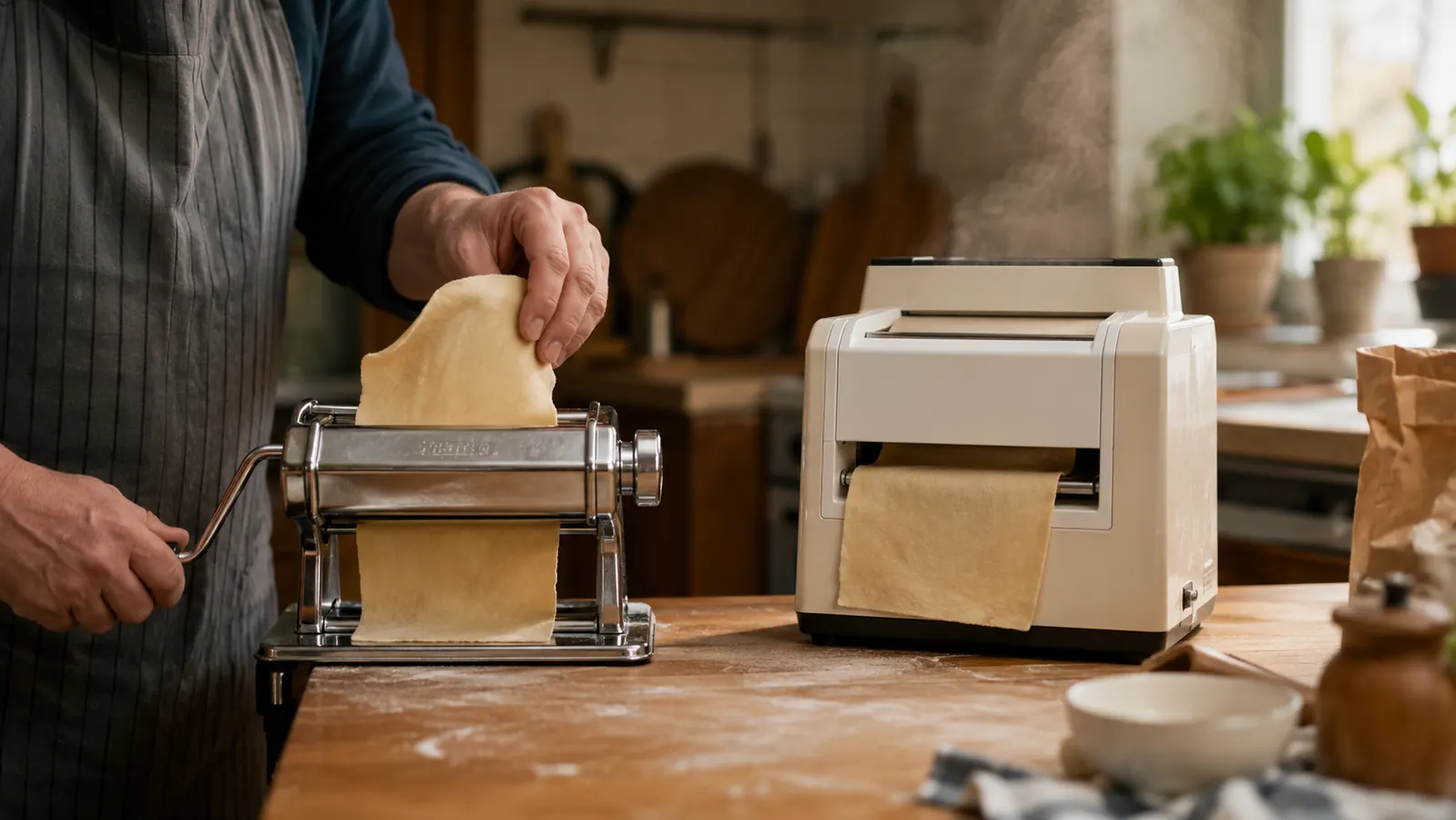
Thirty years behind a line, you learn fast which equipment earns its keep and which ends up shoved in the back of a cabinet. My wife Carol bought me a Marcato Atlas Pasta Machine for my 56th birthday, the classic chrome-plated one, made in Italy, and I was skeptical. I'd made pasta by hand with a rolling pin plenty of times in restaurant kitchens when the sheeter was down. I figured a $200 crank machine was a novelty.
Then my son-in-law showed up with an electric pasta maker he'd gotten off a registry, the kind that mixes, kneads, extrudes, and cuts at the push of a button. He was proud of it. I get why. It looks like something out of a spaceship. So I've now run both, side by side, through a couple hundred batches of dough between the two of us, and I can tell you exactly where each one wins and where it falls flat on its face.
Short answer, if you want one before you read the rest of this. The Marcato Atlas Pasta Machine is the better buy for anyone who actually cares about noodle quality and plans to keep making pasta a habit, not a one-time novelty. The electric pasta maker is the better buy if speed on a weeknight matters more to you than texture, and if you want short shapes like penne. Now here's everything that went into that answer.
| Spec | Marcato Atlas Pasta Machine | Electric Pasta Maker |
|---|---|---|
| Type | Manual, hand-crank | Fully automatic, motor-driven |
| Price (typical) | Around $60 to $80 | Around $150 to $250 |
| Noodle width settings | 9 thickness settings on the roller | Fixed by die shape, no manual thickness dial |
| Mixes and kneads dough | No, you knead by hand first | Yes, built in |
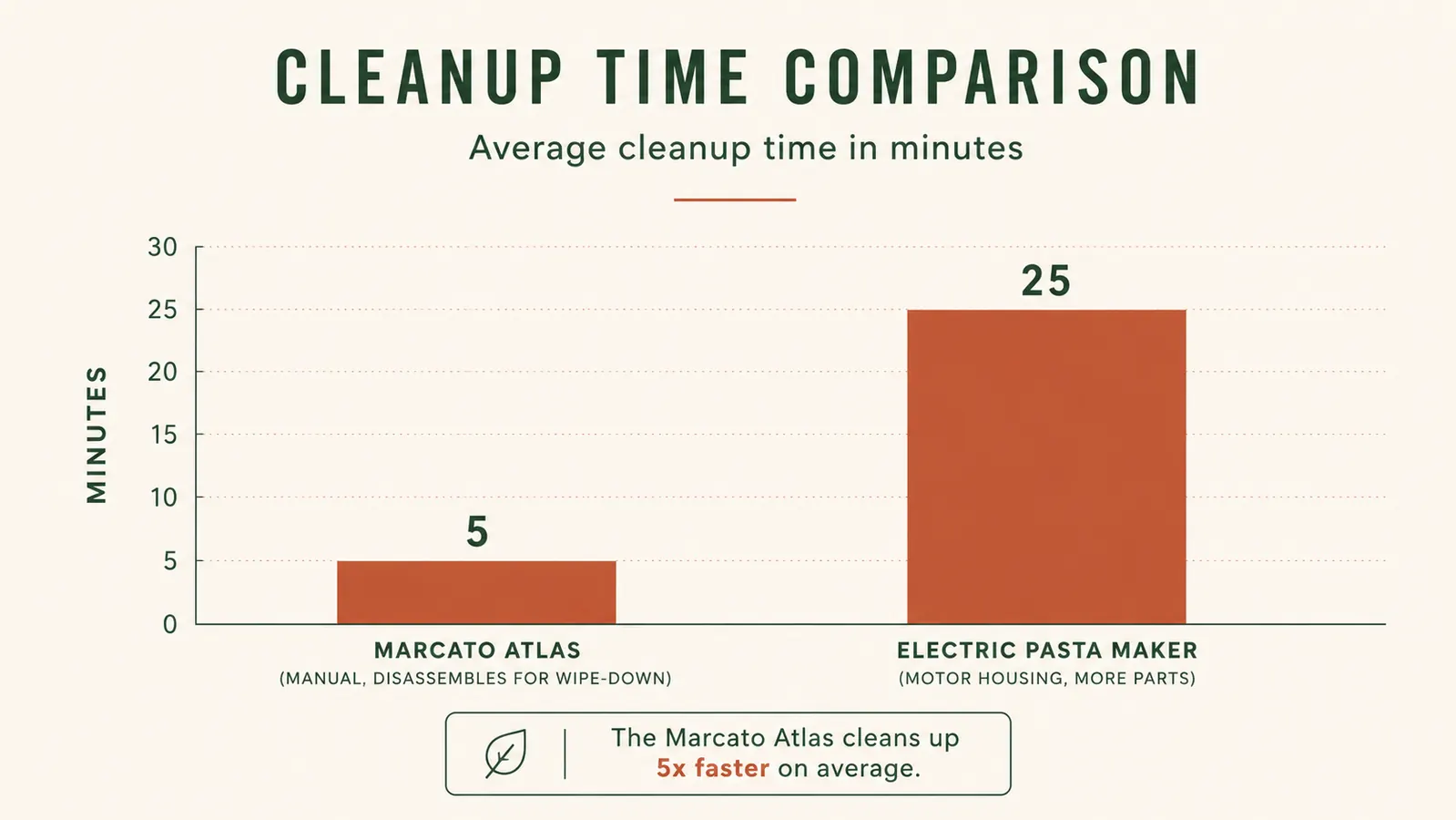
| Cleanup | Wipe down, no water on the rollers, 3 to 4 minutes | Disassemble extruder, wash die and paddle, 10 to 15 minutes |
| Counter footprint | Small, clamps and stores in a drawer | Large, stays on the counter |
| Noise | Silent, just the crank | Motor hum, noticeable in a small kitchen |
| Learning curve | 10 minutes to get the feel of it | Read the manual, dial in dough hydration for the extruder |
| Build material | Chrome-plated steel, made in Italy | Mostly plastic housing with metal internals |
Where the Marcato Atlas Wins
The Atlas does one job, rolling and cutting dough, and it does it better than anything I used in a professional kitchen that wasn't a full commercial sheeter. You knead your dough by hand for about eight to ten minutes, let it rest wrapped in plastic for a half hour, then run it through the Atlas starting at setting one and working down to five or six for fettuccine, thinner for lasagna sheets. The rollers on the Marcato Atlas are precise. Nine thickness settings, and you feel every noodle get more even as you crank it through each pass. My Rocky, well, that's my dog's name, not the pasta, but my granddaughter Emma is the one who actually likes cranking the handle, and even a nine-year-old gets consistent sheets on her third try.
The other thing nobody tells you about the Atlas is how little cleanup it demands. You never run water through those rollers, ever, that would rust the mechanism. You brush off the flour with the little cleaning brush that comes with it, wipe the frame with a dry cloth, and you're done in under five minutes. Compare that to the electric machine, where the extruder disc, the mixing paddle, and the housing all need a proper wash because dough gets packed into every crevice. After a Sunday sauce session, I want to sit down, not spend fifteen minutes with a toothbrush digging pasta dough out of plastic gears.
The Marcato Atlas also just lasts. Mine is going on four years of weekly use and the chrome hasn't pitted, the crank hasn't loosened, and the cutting attachment still lines up clean. It's the kind of tool that gets handed down. My father had a hand-crank meat grinder from the 1960s that still worked when he passed, same idea. Simple machines with fewer parts to fail tend to outlive the fancy ones.
There's a texture difference too, and it's the kind of thing you only notice once someone points it out. Pasta rolled through steel rollers on the Atlas has a slightly different bite than extruded pasta, a bit more tooth to it, because the gluten strands get stretched and compressed rather than pushed through a die under pressure. Carol noticed it before I did, she said the fettuccine off the Atlas held the Bolognese better than store-bought or the extruded stuff. That's not me being sentimental about my own kitchen, that's just how rolled dough behaves versus extruded dough.
Still cranking strong after four years of Sunday sauce
The Marcato Atlas is the one piece of pasta equipment I've never regretted buying. Check today's price on Amazon before you settle for a plastic extruder that'll be in a landfill by 2028.
Amazon Check Today's Price on Amazon →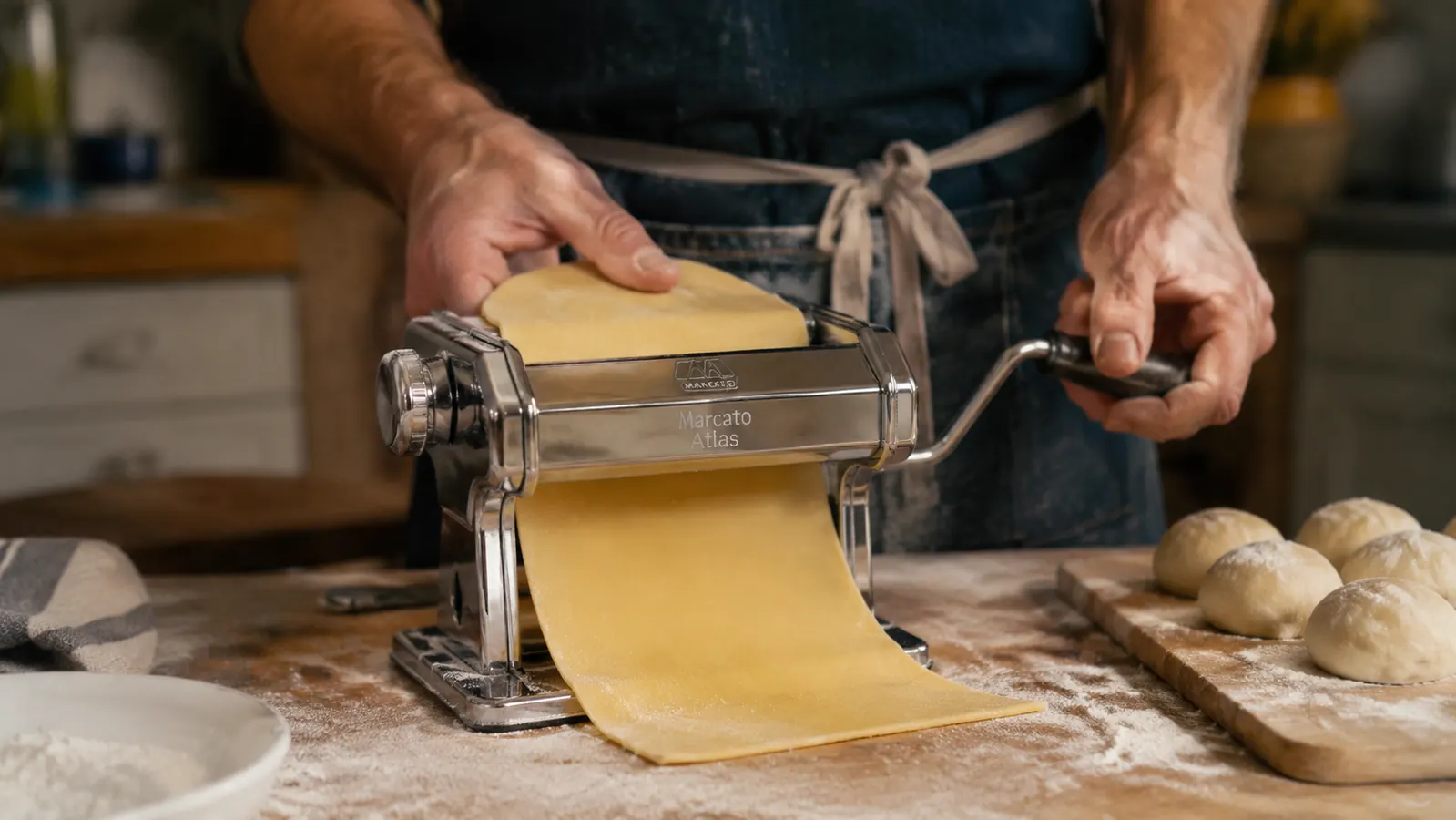
Where the Electric Pasta Maker Wins
I'm not going to sit here and tell you the electric machine is useless, because it isn't. If you want pasta on a Tuesday night after work and you've got twenty minutes total, start to finish, the electric wins that race every time. You dump flour and egg or water into the hopper, hit the button, and in about eight to twelve minutes you've got extruded spaghetti or penne coming out the other end. No kneading, no resting the dough, no cranking. For a family that wants fresh pasta without treating it like a Sunday project, that convenience is real.
The electric machine also handles shapes the Atlas simply can't. Penne, fusilli, macaroni, anything that needs to be extruded through a die rather than rolled flat and cut. If your household eats a lot of short pasta shapes for baked dishes or kids' mac and cheese, the electric unit opens up options the Atlas doesn't touch. The Atlas is a sheeter and a cutter for flat noodles, fettuccine, tagliatelle, lasagna, pappardelle. It's not going to give you rigatoni.
There's also less hands-on technique required with the electric. My son-in-law, who'd never made pasta from scratch in his life, got usable noodles out of his machine on the first try. With the Atlas, your first couple batches usually come out a little uneven because you're learning how thin to roll and how long to knead. That's not a knock on the Atlas, it's just true that a motor doing the kneading removes a variable that trips up beginners.
I'll also give the electric machine credit for consistency across a busy household. If you've got teenagers who want to help but don't have patience for kneading and resting dough, the electric unit keeps them engaged without the frustration of a lumpy, uneven sheet. My son-in-law's kids run the machine themselves now, dumping in measured flour and eggs, and they get a usable batch of noodles every time. That's worth something if you're trying to get more people in your family cooking instead of ordering out.
The Tradeoffs Nobody Puts in the Marketing Copy
Here's what the box for the electric machine doesn't tell you. Those extruder dies are made of plastic on most models in this price range, and plastic dies wear down faster than the bronze dies used on commercial equipment. After a year or two of regular use, I noticed my son-in-law's noodles started coming out with a rougher, less consistent shape, a sign the die was already showing wear. Bronze dies, the kind that give pasta that classic rough texture that holds sauce, aren't standard on machines under a few hundred dollars.
The Atlas has its own tradeoff, and it's honesty, not speed. It takes longer, full stop. Kneading by hand, resting the dough, cranking it through the rollers six or seven times to get the thickness right, cutting it, that's a forty-five minute process from flour to noodle. If you're trying to get dinner on the table in twenty minutes on a weeknight, the Atlas is the wrong tool for that specific night. I use mine on Sundays when I've got time to actually enjoy the process. During the week, honestly, we sometimes just use dried pasta from the pantry, and there's no shame in that.
One more tradeoff worth naming plainly. The electric pasta maker takes up real counter space, and once it's out, most people leave it out because dragging a nine-pound appliance out of a cabinet every time gets old fast. The Atlas clamps on, does its job, and comes right back off. If your kitchen is already tight on counter room, that difference matters more than the spec sheet lets on. I learned that lesson the hard way with a bread machine years ago that never left the pantry shelf because setup felt like a chore.
The electric machine gets you pasta faster. The Marcato Atlas gets you better pasta, and it teaches you something about the dough while it does it.
Who Should Buy the Atlas
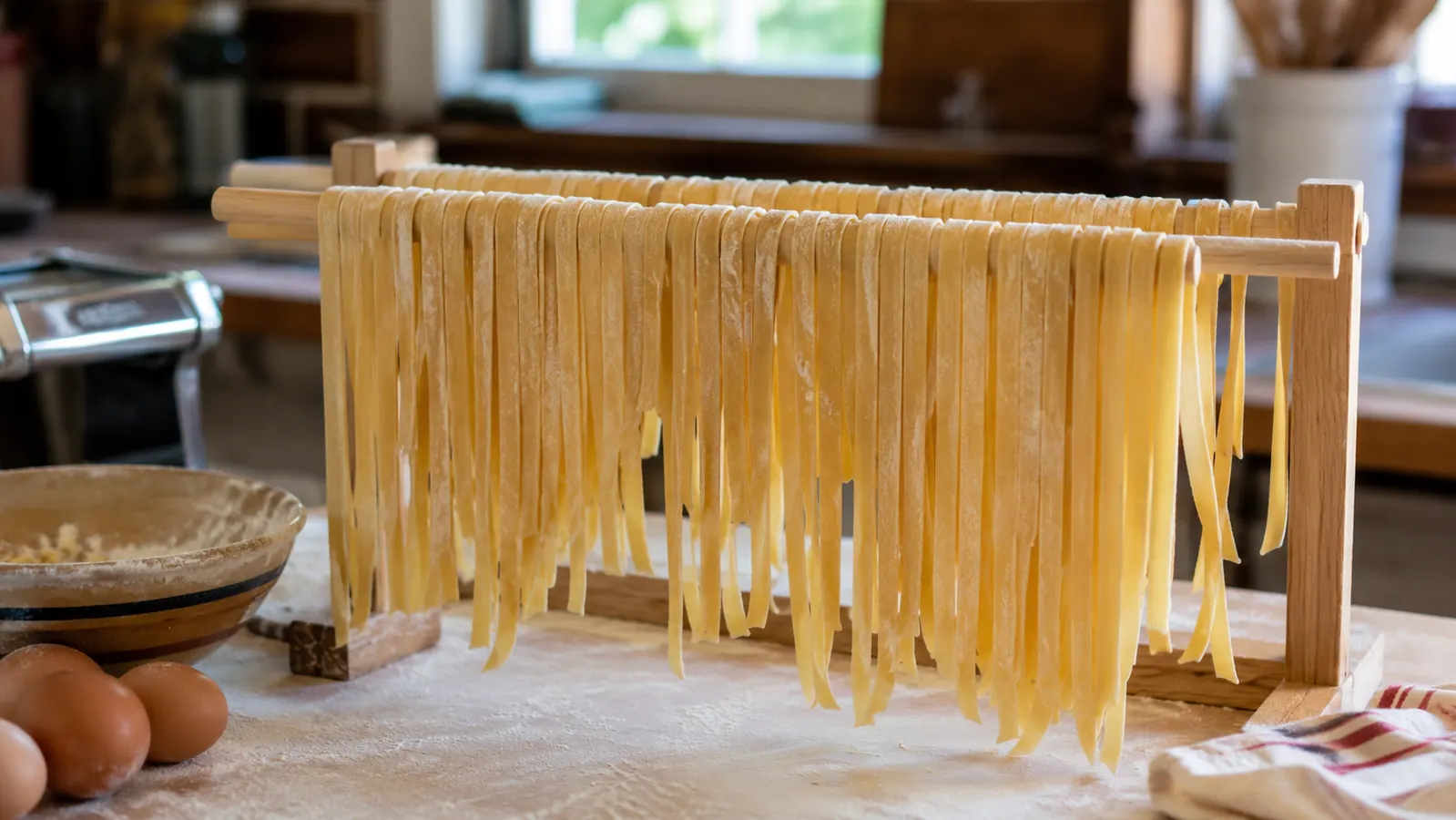
If you already cook, if you've got a Sunday routine or you like the process as much as the result, the Marcato Atlas Pasta Machine is the one that belongs in your kitchen. It's also the better buy if flat noodles, fettuccine, tagliatelle, pappardelle, lasagna sheets, are what your family actually eats most. And if you care about a tool that'll still be working when your grandkids are making their own sauce, the Atlas is built for that. Mine sits in a kitchen drawer between uses and weighs almost nothing to store, which matters if your counter space is already crowded with a stand mixer and a coffee setup like ours is.
Who Should Consider the Electric Instead
If your household wants short pasta shapes, penne and fusilli especially, or if the honest truth is nobody in your house is going to knead dough by hand on a Tuesday, the electric machine solves a real problem. It's also a reasonable pick if you've got mobility issues in your hands or wrists, cranking a manual roller for fifteen minutes isn't nothing if you've got arthritis. I'd just go in with clear eyes about the plastic dies and the extra cleanup time, because those are the two things that turn a promising gadget into something gathering dust by month six.
Thirty years in kitchens taught me simple tools win
The Marcato Atlas has earned a permanent spot on my counter, not in the donation pile. Check today's price on Amazon and see the current deal for yourself.
Amazon Check Today's Price on Amazon →